


Source: Joe Timmerman / Wisconsin Watch
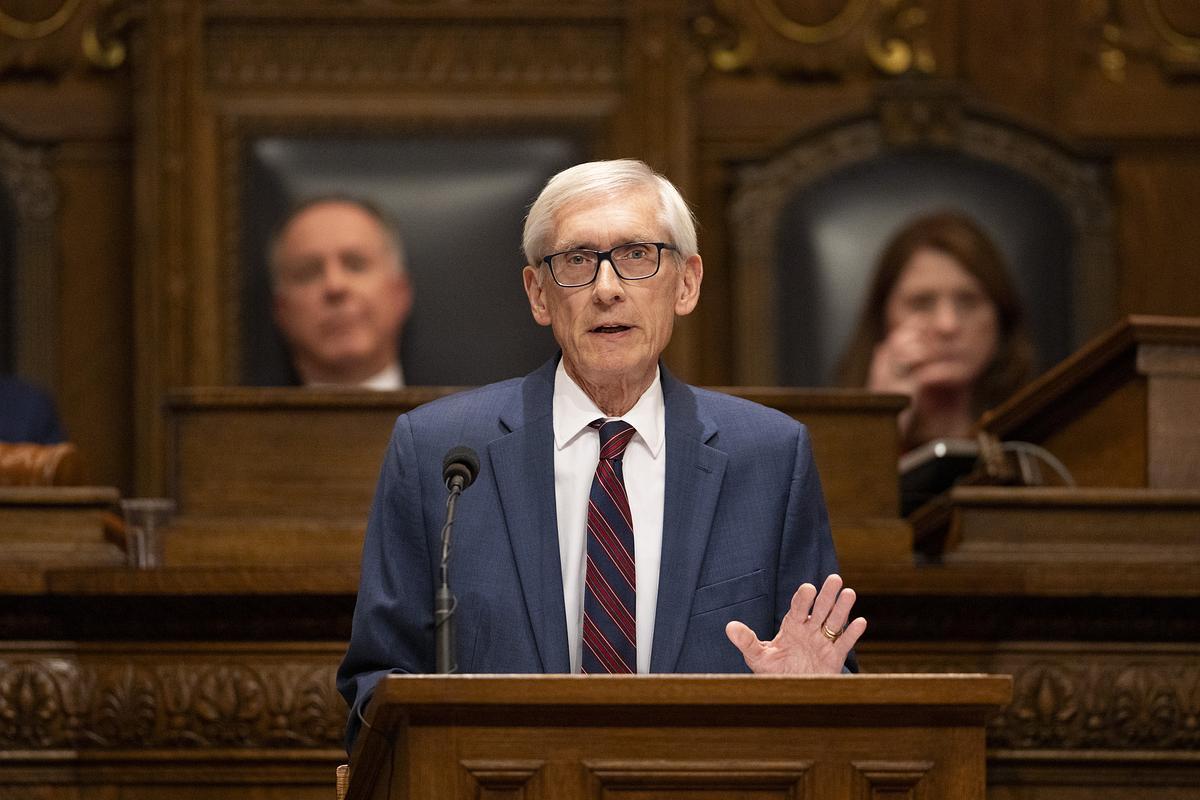
As Tony Evers delivers his final State of the State, he remains crosswise with the GOP Legislature
Feb 16, 2026, 9:06 AM CST


Share
Originally published by Wisconsin Watch.
It’s the last year of Wisconsin Gov. Tony Evers’ final term, and activity at the Capitol since January reflects much of how the last eight years have gone with the Republican Legislature.
GOP lawmakers continue to send conservative bills to Evers’ desk for a likely veto. such as a proposal to allow people to seek legal action for injuries from gender transition procedures when they were a minor. Evers in January called for Assembly Speaker Robin Vos, R-Rochester, to allow a bipartisan bill that would extend postpartum Medicaid to new moms to “finally” reach the governor’s desk, while Vos last week told reporters it wouldn’t advance.
As the political world turns to who might be Wisconsin’s next governor, Evers and Republicans are attempting to negotiate a tax cut in the wake of a projected $2.4 billion state surplus reported in January. The last time there was an open governor’s seat the state faced a multibillion-dollar deficit. Surpluses have been a regular feature of the last eight years of split government.
“There have been plenty of times in the last eight years where we have had a disagreement and we had a public argument with Gov. Evers,” Vos said last week. “I think there’s a long list of things where I think he’s just wrong on the issue. But on this one, considering the fact that he came out and sincerely said he wants to do something on property taxes. We feel the same. I don’t know why we wouldn’t negotiate in good faith to try to find something that can actually get across the finish line.”
Evers, who is not seeking reelection in 2026, will give his final State of the State address before the Legislature at 7 p.m. on Tuesday. Part of Evers’ legacy during his two terms as governor is his navigation of split government and the oftentimes contentious relationship between his administration and the legislative branch.
“We have proven that despite these divisive times, we still believe in working together to get good things done for the people that we serve,” Evers told reporters in January as he called for bipartisan efforts on goals for his final year in office. His office did not respond to questions about his relationship with the Legislature during his time as governor.
Evers’ defeat of Republican Gov. Scott Walker in 2018 marked a change in the Legislature’s relationship with the governor’s office. For eight years prior, a Republican governor and Legislature meant conservative ideas — slashing the power of public sector unions, strict voter ID, concealed carry, corporate tax cuts — became law with ease. Evers, a moderate Democrat, became a check on that power.
In the weeks before Evers officially took office, Walker and the Republican-led Senate and Assembly enacted laws in the lame duck session limiting the power of the incoming Democratic administration.
Since then, and despite Evers’ frequent calls for bipartisanship, the governor and legislative Republicans have been engaged in a yearslong tug-of-war over their powers. It’s a relationship that has been marked by court cases, record-breaking numbers of gubernatorial vetoes and the Legislature advancing numerous constitutional amendments that don’t need Evers’ signature. While Evers has served as a check on far right legislation, Republicans have shrugged at Evers’ calls for special sessions on Democratic issues such as abortion rights and gun safety.
“I think the most telling was the 2020 COVID experience,” said Barry Burden, director of the Elections Research Center and political science professor at the University of Wisconsin-Madison. “The state was facing a bunch of crises that year. … There were so many things the state needed to address and there was not a single bill passed in the Legislature and sent to his desk that year. Instead, the two branches were mostly pointing fingers at each other.”
Despite the partisan battles, every other year a compromise between the two sides has brought the biennial state budget across the finish line on schedule and with billions of dollars in unspent tax revenue that has shored up the state’s fiscal health.
“The governor is open to meeting with anybody to try and get things done,” said Rep. Christine Sinicki, D-Milwaukee, who was first elected to the Assembly in 1998.
His easygoing demeanor has helped that relationship with the Legislature, Sinicki said. Republicans seem to recognize that, too.
“When you talk to Gov. Evers, you realize he’s sincere,” Senate Majority Leader Devin LeMahieu, R-Oostburg, told the audience at a recent WisPolitics event. “I think he’s a sincere person, but (there’s) obviously a lot of things we don’t necessarily agree on.”
Conflict and the courts
Several power disputes between Evers and the Legislature have ended up before the Wisconsin Supreme Court, which transitioned from a conservative to liberal majority during Evers’ two terms. They include:
- In 2020, the court’s conservative majority sided with Republican lawmakers who challenged the Evers administration’s powers when the governor’s office extended the “Safer at Home” order during the coronavirus pandemic.
- In late 2023, the court’s new liberal majority struck down the Republican legislative maps, ruling they were unconstitutional. Evers in 2024 signed the current maps into law.
- In 2025, the liberal majority upheld the governor’s veto powers after Evers used his veto pen to raise school district revenue limits annually for the next 400 years.
Sen. Chris Kapenga, R-Delafield, is leading a constitutional amendment to prevent the governor from using veto powers to increase taxes or fees.
“The state Supreme Court has given the executive branch unprecedented power,” Kapenga said in a statement to Wisconsin Watch. “Nowhere is this more apparent than in the use of the partial veto pen.”
One of the other significant disagreements of the Evers era that reached the Supreme Court has been the oversight of administrative rules, or policy changes sought by executive agencies like the Department of Natural Resources.
Republicans have long criticized these policies as red tape for Wisconsin businesses. The 2018 lame duck legislation gave the Legislature the ability to delay the implementation of policies from state agencies, such as a ban on conversion therapy or updating surface water quality standards.
Evers sued the Legislature on the issue. In 2025, the Supreme Court’s liberal majority last summer ruled that a key legislative committee that oversees administrative rules could not block the Evers administration’s policies from going into effect. The Legislature is essentially in an advisory role now, said Rep. Adam Neylon, R-Pewaukee, one of the co-chairs of the Joint Committee on Review of Administrative Rules.
“I think that people are expecting more from an executive role or from the governor and it’s in some ways disrupted the balance of the co-equal branches of government,” Neylon said. “I think, especially a lot of the court decisions upholding the 400-year veto or Evers v. Marklein, which took away our oversight of the rulemaking process, I think we’re in an era now that the power has been slowly drifting into the executive and I think real people do feel that.”
The balance of power is a legitimate concern for the Legislature to have, but Republicans prior to the Supreme Court’s decision asserted control over the process in ways that often negatively affected public health issues, said Sen. Kelda Roys, D-Madison, one of the Democrats running for governor and a member of the administrative rules committee.
“The most important legacy is the court decision, Evers v. Marklein, that says, basically, the Legislature can’t be judge, jury and executioner,” Roys said.
What’s next
Whether the partisan battles of split government continue depends on where Wisconsin voters take the state during the 2026 elections later this year. Evers’ departure leaves an open governor’s race. New legislative maps and Democratic gains in both chambers in 2024 set up real competition for control of the Legislature in 2026.
A unified government with one-party control of the executive and legislative branches could bring a burst of new laws starting in 2027, Burden said.
But more split government conflicts are also possible, and none of the candidates for governor appears as interested in bipartisan negotiations as Evers, Burden said. Republican U.S. Rep. Tom Tiffany cleared the GOP primary field in January. Seven major Democrats are running for governor, including Roys, former Lt. Gov. Mandela Barnes, former Department of Administration Secretary Joel Brennan, Milwaukee County Executive David Crowley, Madison state Rep. Francesca Hong, former Wisconsin Economic Development Corp. CEO Missy Hughes and Lt. Gov. Sara Rodriguez.
“He has a more conciliatory tone, I think, than Democrats would like to see,” Burden said. “So if we get divided government again next year in some form, whether it’s a Tiffany governorship or a Democratic governorship and the Legislature at least partly divided, I think the kind of stalemate that we’ve seen will continue and the option to go to the courts or to use constitutional amendments to get around the governor will still be a popular method.”

Want More Local News?

Civic Media
Civic Media Inc.
The Civic Media App
Put us in your pocket.